
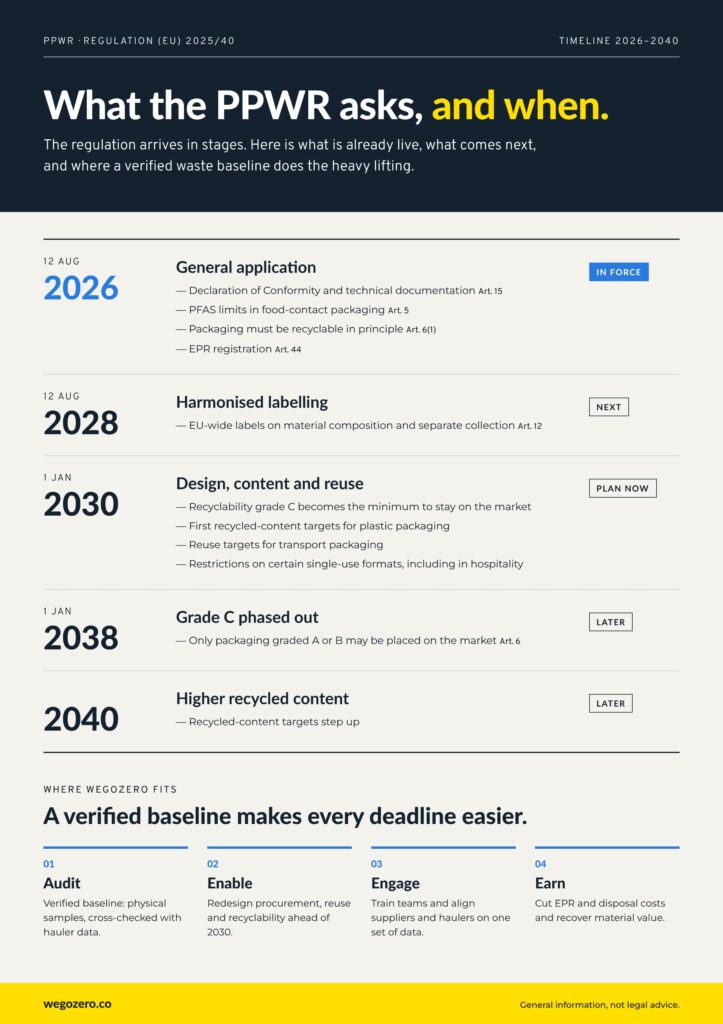
The EU’s Packaging and Packaging Waste Regulation (PPWR) is no longer on the horizon. It’s here. Regulation (EU) 2025/40 has applied since 12 August 2026, replacing the old Packaging Directive. For companies that make, import, sell or simply use packaging in Europe, that date marks the start of a compliance journey that runs well into the next decade.
The good news: most of what the PPWR asks for comes down to knowing your packaging, measuring your waste, and redesigning systems so less is wasted in the first place. That is exactly what WeGoZero has been doing for organisations across Europe since 2020.
What is the PPWR, and why does it matter now?
The PPWR replaces the 1994 Packaging Directive with a single regulation that applies directly and identically in all 27 Member States, without waiting for national legislation. The European Commission’s packaging waste policy page gives an overview of the framework and its guidance documents.
National rules don’t disappear, however. Germany, for example, adopted a national adaptation act (VerpackDG) that replaces the old Verpackungsgesetz and took effect alongside the PPWR on 12 August 2026.
The regulation also reaches further than many businesses expect. It applies to any economic operator that places packaging or packaged goods on the EU market, and it defines four roles (manufacturer, importer, distributor and producer), each with distinct obligations. Many companies hold several roles at once without realising it.
The PPWR timeline: what applies now and what’s coming
The PPWR is phased. Understanding the sequence is the first step to a realistic compliance plan.
Already in force (from 12 August 2026): the Declaration of Conformity and technical documentation (Art. 15), restricted-substance limits including PFAS limits in food-contact packaging (Art. 5), the requirement that packaging be recyclable in principle (Art. 6(1)), and EPR registration (Art. 44).
2028: Harmonised labelling on material composition and separate collection applies from 12 August 2028 (Art. 12).
2030 and beyond: Grade C becomes the minimum recyclability grade from 1 January 2030, and grade C itself is phased out from 1 January 2038, leaving only grades A and B. Packaging minimisation, recycled-content targets, the 50% empty-space cap, reuse targets for transport packaging and restrictions on certain single-use formats, including in hospitality, phase in on set dates through to 2040.
In short, 2026 is about documentation and registration. The period to 2030 is about redesigning how packaging flows through your operations, and that takes time to get right.
Why PPWR compliance is really a data problem
Most companies already meet the physical requirements. The gap is proving it. Few organisations know with any precision how much packaging enters their sites, what it’s made of, which streams are recyclable, or where reuse would actually work.
Without that baseline, it’s impossible to set credible reuse targets, negotiate with suppliers, forecast EPR costs, or report consistently under frameworks like CSRD. (We’ve written about the same challenge in how waste audits support CSRD double materiality.) That is where WeGoZero comes in.
How WeGoZero supports PPWR compliance
WeGoZero is an Amsterdam-based circular economy and zero-waste consultancy. Our flagship Zero Waste 360° for Business™ programme follows four stages: Audit, Enable, Engage, Earn. Each maps directly onto what the PPWR asks of businesses.
1. Audit: build your packaging waste baseline
Every compliance strategy starts with facts. Our waste audits and reporting use 24-hour physical samples to show exactly which packaging materials arrive at and leave your sites, in what volumes, and how they are currently handled. We cross-check findings against hauler data to close the gap between what’s reported and what’s really in the bin.
For multi-site organisations, our Smart Waste Audit, delivered with our technology partner Rego, lets your own teams capture waste data through an app, while WeGoZero provides the expert analysis, hauler cross-check and reporting. It’s a fast, scalable way to establish a PPWR-ready baseline across a portfolio.
2. Enable: redesign systems for reuse and recyclability
Audit data shows where the biggest opportunities lie. We help you:
- Identify packaging streams that are hard to recycle and likely to fall short of future recyclability grades, so you can raise them with suppliers early.
- Design reuse systems for transport packaging such as pallets, crates and wrapping, ahead of the PPWR reuse targets.
- Write packaging requirements into procurement specifications, so suppliers carry their share of the compliance burden.
- Prepare hotels and food-service operations for the phase-out of certain single-use formats through Zero Waste 360° for Hospitality™.
3. Engage: bring your people and partners with you
Separate collection and reuse only work if people use them. We run staff engagement and training that turns new sorting and reuse systems into daily habits, and we support conversations with suppliers, facility managers and waste haulers so everyone in the chain works from the same data.
4. Earn: turn compliance into value
Compliance doesn’t have to be purely a cost. Less packaging means lower EPR fees and lower disposal costs, and better-separated streams carry real recovery value. Our goal is for every client to see the PPWR as a lever for operational savings, not just another reporting obligation.
Proven results across Europe
WeGoZero has worked with more than 23 organisations across Europe, spanning enterprise offices, hospitality, sports venues and data centres. For one global technology operator, we delivered waste audits across seven hyperscale data centre sites over several years, achieving an average 20% improvement in waste diversion.
We also work within the frameworks your ESG team already uses, including CSRD, ISO 14001, TRUE, LEED and BREEAM, so PPWR-related data feeds straight into your wider sustainability reporting rather than sitting in a separate silo.
Where WeGoZero fits in your PPWR team
PPWR compliance involves several disciplines. Chemical testing, Declarations of Conformity and legal interpretation belong with specialised labs and legal advisers. WeGoZero complements them by providing the operational evidence, waste data and system redesign that make those declarations credible and your targets achievable. Think of us as the partner who makes sure what’s on paper actually happens on site.
Frequently asked questions about PPWR
When does the PPWR apply?
The PPWR has applied since 12 August 2026. Further obligations, including labelling, recyclability grades, recycled content and reuse targets, phase in between 2028 and 2040. The full legal text is available on EUR-Lex.
Does the PPWR apply to my business if we don’t manufacture packaging?
Very likely. The regulation covers importers, distributors and businesses that place packaged goods on the market, and the reuse and single-use rules also affect companies that use packaging in their operations, including hospitality and logistics.
What is the first step towards PPWR compliance?
Establish a baseline: know which packaging you handle, in what volumes, and what happens to it. A packaging waste audit gives you that foundation.
Can WeGoZero sign our Declaration of Conformity?
No. The Declaration of Conformity is the responsibility of the relevant economic operator, usually supported by testing labs and legal advisers. WeGoZero supplies the waste and operational data and the reuse and recyclability strategy that support it.
How can I estimate the value hidden in my waste?
Try our free Waste to Value Calculator. It gives an instant estimate of the total recoverable value of your organisation’s waste. It is an estimate rather than an audit, and a useful first step before a full assessment.
Get ready for the next PPWR milestones
The first deadline has passed, but the most demanding PPWR requirements are still ahead, and organisations that start measuring now will have the easiest path to 2030. Talk to WeGoZero about a packaging waste audit and a PPWR-ready roadmap for your sites.
Book a consultation · Try the Waste to Value Calculator
This article provides general information about Regulation (EU) 2025/40 and is not legal advice.
