
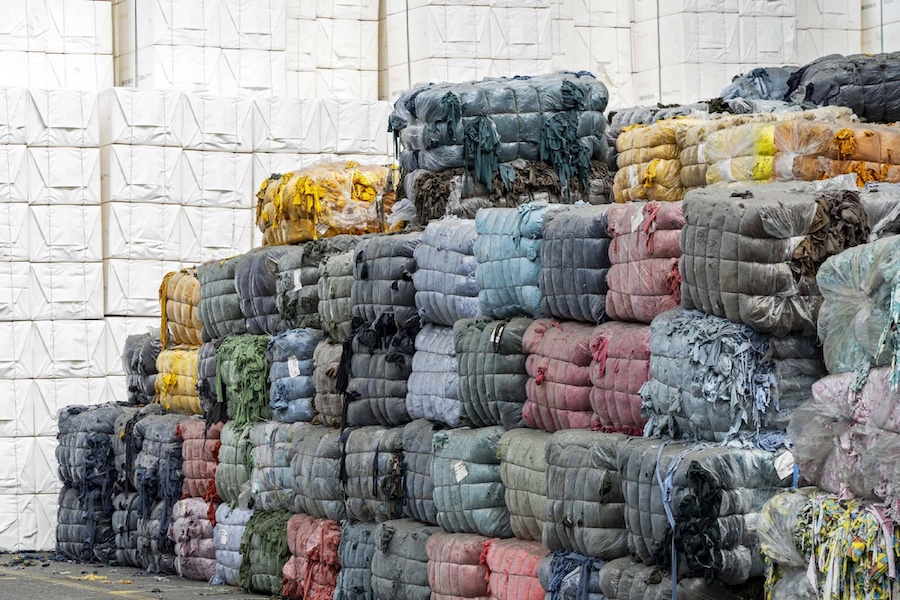
Every year, the average EU citizen throws away around 16 kg of textiles. Most of it never gets a second life.
Clothing recycling is usually presented as the solution to this problem: the reassuring endpoint where an old t-shirt becomes a new one. The reality is less comfortable. Textile-to-textile recycling is still rare, technically difficult and expensive, and less than 1% of the material in discarded clothing is turned back into clothing. Most of what we hand over is shredded into rags and insulation, exported, incinerated or landfilled.
That does not make recycling useless. It makes it a last resort rather than a first choice.
This article explains what clothing recycling actually involves, why it is so difficult to do well, what happens to a garment after it goes into a collection bin, and where brands and consumers can recover far more value through reuse, repair, resale and upcycling. It also looks at what the EU’s new rules on unsold stock mean for fashion businesses.
1. What is clothing recycling?
Clothing recycling is the process of sorting, transforming and reprocessing garments and textiles into new products, whether clothing or non-clothing items. Clothing recycling should not be confused with clothing reuse, since recycling involves breaking textiles down and transforming them into new fibres or materials. Although recycling can recover value from unwanted clothes, it requires technology, time, resources and in some cases weakens fibre quality. This is why recycling should not always be your first option when dealing with unwanted clothes!
2. What is the problem with clothing recycling?
According to the European Environmental Agency, in 2020 each EU citizen generated about 16 kg of textile waste annually and only about 4.4kg were collected for reuse and recycling, with the remaining 11.6 kg ending up in mixed household waste. This means that the processes of giving items a new life are not being effective.
Globally, the problem is even worst: approximately 75% of textile waste is landfilled, 25% is reused or recycled, and less than 1% of all textiles are recycled back into clothing (Juanga-Labayen et al., 2022), meaning textile-to-textile recycling is rare and many fabrics are downcycled into industrial rags or padding for instance. In other words, clothing recycling exists but is far from fulfilling the needs of a circular fashion model.
So, what happens after we throw our clothes in the bin?
2.1 What are the main options for unwanted clothes?
| Option | What it means | Best used when | Main limitation |
| Reuse | Clothes are kept in their original form and used again through donation, resale, swapping or second-hand use. | The garment is still wearable. | Depends on quality, demand and collection systems. |
| Upcycling | Old or unwanted garments are creatively transformed into new, often higher-value products. | The material is usable but the original garment cannot easily be resold. | Can be labour-intensive and harder to scale. |
| Mechanical recycling | Fabrics are shredded into small fragments and turned into new yarn. | The textile can be sorted by fibre type and processed physically. | Fibre quality often decreases because shredding shortens and weakens fibres. |
| Chemical recycling | Fibres or polymers are broken down to a molecular level through a chemical process and turned into new fibres. | Materials need deeper separation or regeneration. | Requires specialised technology, energy, chemicals and infrastructure. |
| Closed-loop recycling | Textile material is recycled back into a similar textile product. | The material can be recovered at high enough quality. | Difficult to achieve at scale, especially with blended fabrics. |
| Open-loop recycling / downcycling | Textile material is turned into a different or lower-value product, such as insulation, rags, filling or construction materials. | Clothes cannot be reused or recycled back into garments. | It recovers value, but usually not at the same level as the original garment. |
Ideally, when a piece of clothing arrives at a sorting facility, the decision about its future should follow the order shown in the table above, depending on the item’s condition and characteristics. However, many garments are downcycled, exported, incinerated or landfilled instead.
2.2 Why is clothing recycling so difficult these days?
One of the main reasons is that most garments are not designed to be recycled. Modern clothing often combines different fibres, synthetic or mixed materials, dyes, coatings, zippers, buttons, labels and finishes. These elements make it harder to sort garments by material type and recover high-quality fibres. Textile sorting is also expensive and labour-intensive, and sorting technologies are not automated enough. The poor quality of modern clothing makes it hard for the processes of mechanical and chemical recycling to be an option.
Another difficulty is that recycling can reduce material value. Mechanical recycling usually involves shredding or pulling textiles apart into fibres, but this can shorten and weaken the fibres. As a result, recycled textiles are often not turned into new clothing, but into lower-value products such as insulation, stuffing, industrial cloths or rags. This is known as downcycling. Chemical recycling may offer higher-quality recovery in some cases, but it requires specialised technology, energy, chemicals and infrastructure.
For these reasons, clothing recycling should not be treated as the first or only solution. Recycling becomes most useful when clothes can no longer be worn, repaired, resold or remade. The real challenge is therefore not only how to recycle more clothes, but how to keep clothing in use for longer and recover materials at the highest possible value. This includes a shift from the linear textile model to a circular fashion model, which can still be profitable and fulfill our needs, as proposed in a study conducted by The Ellen MacArthur Foundation.
3. Where to drop-off unwanted clothes? How can you find a bin near you?
Across Europe, there are certain platforms to help you find a clothing recycling bin near you. Recycle Now helps citizens from England and Northern Ireland to find clothing recycling bins nearby. Sympany offers a similar service in The Netherlands.
In France, the government subsidized organization ReFashion has an initiative called The Repair Bonus which can offer you a repair voucher up to 25€ if you repair your clothing or shoes to an approved local repairer. In addition, it also helps you find a clothing recycling bin near you. Furthermore, ReFashionPro helps brands transition to a circular economy through help with legal compliance and financial incentives. Local tailors and cobblers can join the network to offer subsidized repairs via the “Bonus Réparation,” driving new customers to their shops.
The Kid to Kid store which operates in Portugal and Spain can offer store credit or instant payment in cash in return for all sorts of unused kid items (children’s clothing, baby equipment and much more). The items are then available for sale at their stores.
Another option is to participate in The Swap Club events, where you give your old items, receive points and exchange the points for other second-hand clothing, giving the fast-fashion sensation while contributing to the circular economy. It is also a great chance to engage with the local community and meet new people.
Lastly, resale platforms like Vinted or Depop make it easy to engage in circular fashion by giving unwanted clothing a second life while allowing users to make money from items they no longer wear.
4. Why is it important to know where to put your unwanted clothing?
Whether you want to donate or recycle your clothing, the most important part is to understand where the clothes actually go after you drop them off. Clothing circularity should not work as an “out of sight, out of mind” system.
Some programmes may sound easy and appealing but they can also hide uncomfortable realities. One example is H&Ms Group Garment Collecting programme, launched in 2013 with intentions of promoting a circular fashion model and “closing the loop” where customers can drop off old or unwanted clothing, home textiles, or shoes from any brand and in any condition in every H&M store and receive a 15% discount voucher in return. H&M states that collected items are sorted for resale, repurposing/recycling, textile-to-textile recycling or disposal, depending on their condition. Its current public information states that, in 2025, 63% of collected garments and textiles were classified for resale, 24% for repurposing/recycling, 3% for textile-to-textile recycling, and around 10% for disposal routes.
However, investigations have raised concerns about the transparency of these collection systems and clothing destinations. In 2023, two Swedish journalists conducted an investigation by dropping-off 10 clean and wearable garments on different H&M stores with airtags attached to them to trace their journey. The investigation found that none of the garments remained in Sweden; all were first transported more than 1,000 kilometres to sorting facilities in Germany. Some garments were later shipped to countries like Ghana or Benin, where there can be found some of the worst dumping grounds in the world, harming the basic needs of the local community. What H&M is doing can be defined by some groups as Waste Colonialism, where countries in the Global North send excess clothing to countries in the Global South, shifting the environmental and social burden onto local communities. This raises concerns not only about transparency but also about hidden transport emissions from the thousands of kilometres these clothes travel.
This may be the reality of many clothing items that we think we are donating. Dropping clothes into a collection bin should not make us assume the problem has been solved. A take-back programme, donation bin or recycling scheme is only truly circular if there is transparency about what happens afterwards. Without this information, clothing “recycling” can become an actual waste burden elsewhere.
For this reason, the best approach is to prioritise the options that keep clothing in use for as long as possible. If a garment is still wearable, resale, repair, swapping or direct donation to a trusted local organisation may preserve more value than placing it in a generic collection bin. Recycling should be the next step only when clothes can no longer be worn, repaired or reused. In circular fashion, the goal is not simply to remove unwanted clothes from our homes, but to make sure they do not become someone else’s environmental problem.
So, whether you want to donate or recycle your clothing, the most important part is to understand where to deliver the unwanted clothing to avoid clothing waste.
5. How can brands benefit from excess clothing?
Excess clothing does not have to be treated only as waste. It can present business opportunities for fashion brands aiming to improve brand value, reduce costs or unlock new revenue streams. Fashion brands access the excess clothing through their unsold inventory but they can also be a bridge between customer’s unwanted clothing and a more circular destination. Instead of following a linear model where clothes are produced, sold and discarded, brands can recover value through upcycling, resale, repair, donation and recycling.
5.1 Turn excess clothing into unique upcycled collections
Upcycling can become a great way of increasing brand value through uniqueness. Instead of producing clothes from virgin materials, brands can use discarded textiles and turn them into limited-edition collections, increasing the material value. This gives waste a story and makes every product feel more original.
A brand that has mastered upcycling is Freitag, which was founded in 1993 by transforming used truck tarps into bags. They have expanded their creativity and now also sell iPhone cases made from worn-out ski boots and bags made from airbags. In their 2025 impact statement, they state that 79.9% of their materials are upcycled and this is central to their brand identity, which creates consumer interest.
Upcycling is not only an environmental strategy but also a brand strategy.
5.2 Create resale and repair business models
If garments are still wearable, resale and repair usually preserve more value than recycling. Brands can create second-hand platforms, repair services or trade-in programmes that extend the life of their products while keeping customers connected to the brand.
Patagonia’s Worn Wear is a strong example. Patagonia describes Worn Wear as a programme that began with clothing swaps and evolved into pop-ups, repair events, an online resale shop and a store dedicated to used gear. The goal is to reduce impact by changing the way people consume. Patagonia also allows customers to trade in eligible used gear for store credit and encourages keeping gear in use for longer before recycling becomes necessary.
This type of model can benefit brands in several ways: it creates a new revenue stream from products that already exist, strengthens customer loyalty, attracts sustainability-conscious consumers and reduces the amount of clothing sent directly to disposal.
5.3 Build responsible donation partnerships
Donation, when done with credible partners, increases social value and this way it can be an asset to the company.
In the UK, the charity Oxfam takes stock donations of clothing, accessories and so on and later distributes them for resale in UK-wide and online charity shops to fund Oxfam’s mission.
Another example is Moda re-, a Spanish circular fashion initiative promoted by Cáritas. The initiative offers the largest network of 2nd hand shops in Spain. With the expansion of its operations of the full cycle of used clothing, including collection, preparation for reuse, recycling, social donation and sale, Moda re- has a positive environmental and social impact, while creating employment opportunities.
5.4 Use recycled materials in new products
When clothes can no longer be reused, repaired, resold or donated, recycling becomes the next option. Recycled materials can also support brand value. Research on circular business models in fashion shows that large retailers increasingly use recycled fibres, circular collections, take-back schemes, repair, resale and transparency as part of their circular strategies. The same study notes that recycled materials can become selling points when they are implemented beyond small pilot projects and communicated clearly to customers.
Recycling is an important step to close the loop!
5.5 Why data matters
For brands, the business opportunity only becomes credible when it is backed by data. A brand should be able to answer:
| Question brands should track | Why it matters |
| How much excess clothing is generated? | Shows the scale of the problem. |
| Where does the excess clothing come from? | Helps identify overproduction, returns, damaged stock or unsold collections. |
| How much is resold? | Measures revenue recovery. |
| How much is repaired or upcycled? | Shows value preservation. |
| How much is donated? | Supports social impact reporting. |
| How much is recycled? | Measures material recovery. |
| How much is discarded? | Reveals the remaining waste problem. |
| Which partners handle the clothing? | Improves traceability and reduces greenwashing risk. |
WeGoZero can help you identify where excess clothing is created, identify reuse, repair, resale and donation partners and the best recycling solutions. Book a free audit call to understand where your excess clothing could become a circular value.
6. What does the future hold regarding clothing recycling?
The good news is that the EU is being more strict regarding unwanted clothing. Under the Ecodesign for Sustainable Products Regulation (ESPR), there is a new regulation prohibiting the destruction of unsold clothes, clothing accessories and shoes. It has applied since July 19, 2026, for large companies in the EU and medium-sized companies must comply until July 19 2030. It means that businesses can no longer treat excess stock as a hidden problem to be destroyed when it’s not commercially viable anymore. It obliges fashion brands to find circular solutions for unsold clothing being reuse, resale, recycling or donation to charity. It could mean brands will plan better or invest in recycling technology. Adopting the initiatives mentioned above can help brands comply with the regulation.
Furthermore, the EU is funding the tExtended project which aims to improve circularity of discarded textiles. One of its trials in Waregem, Belgium is testing a machine aiming to revolutionize clothing recycling. The project uses the PURFI’s “soft mechanical recycling” technique, which preserves the quality of fibres, helping recycled fibres to be turned into clothing rather than being downcycled. The project also involves several industry partners testing recycled materials in new textile applications. For example, pilot work is already producing recycled denim from a mix of production waste and old clothes, while the long-term goal is to develop denim made entirely from pure recycled cotton.
7. What is the role of clothing recycling in circular fashion?
Recycling is the last of the 7 sustainable Rs in fashion- Rethink, Refuse, Reuse, Repair, Repurpose, Resell and Recycle- meaning it should be treated as a last resort only when higher-value options are no longer possible. Furthermore, there are still some changes required in the current fashion model for recycling to reach its fullest potential. Brands need to reduce overproduction, design clothes that last longer, use materials that are easier to recycle, improve collection and sorting systems, and be transparent about what happens after garments are collected. Consumers also play a role by choosing repair, resale, swapping or trusted donation channels before recycling.
In the end, clothing recycling is not the full answer to fashion waste. It is one part of a wider circular fashion system that starts with better design, more responsible production, longer product use and clearer end-of-life solutions. You can learn more about this wider model in our blog post: What is circular fashion?.
The takeaway
Clothing recycling is not the best option. It is the option that remains once the better ones have been used up.
Before a garment is shredded, there are almost always questions worth asking first: can it still be worn, repaired, resold, swapped or remade into something else? Answering those questions in the right order preserves far more value — environmental, social and financial — than increasing the volume of clothes collected for recycling.
For consumers, that means choosing the destination deliberately rather than dropping everything into the nearest bin and assuming the problem is solved. For brands, it means knowing the numbers: how much excess clothing exists, where it comes from, where it goes and who handles it along the way. Without that data, circularity is a claim rather than a strategy — and, since July 2026, it is also a compliance risk.
If you want to know where your excess clothing is created and what could be done with it instead, book a free audit call with WeGoZero. We will help you map the flows, find the right reuse, repair, resale and donation partners, and identify the recycling solutions worth using when recycling really is the right answer.
