
The Office. Not only is it one of the most popular sitcoms from the 2000’s, the words also describe a place where a lot of us spend our daily working hours. And all those hours add up to something nobody puts on the agenda: bins. A circular office simply flips that logic — instead of buying, using and binning, materials stay in use for as long as possible, and whatever is left over becomes an input for something else. The nice surprise? It usually costs less than the linear version. Here are 10 ideas to get you there.
Learn more about our Circular Office Ideas – Designing Out Waste at Work Workshop
What is a circular office, exactly?
A circular office is a workplace designed so that resources loop rather than end. Furniture gets repaired instead of replaced, food scraps become compost, old laptops become raw material, and paper mostly stops existing. It borrows its logic from the circular economy — design out waste, keep products and materials in use, regenerate natural systems — and applies it to the very ordinary things that happen between 9 and 6.
The reason it matters commercially is that most of the loops also save money: lower disposal fees, fewer purchases, less storage.
The ten ideas below are grouped by where the change actually happens, because that determines who has to sign off on it. Three of them sit in the physical space, four sit in the contracts and purchasing decisions you renew anyway, and three sit with your colleagues. Start wherever you have the least resistance — the loops reinforce each other once a few are running.
How do you design a circular office space?
The building itself does a lot of the work before anyone changes their habits. Design decisions are also the ones you live with longest: a desk bought this year is still there in 2033, and a kitchen fitted out badly keeps costing you every single day it’s used. That makes them the most expensive things to get wrong and the most rewarding to get right.
So the three ideas in this section all deal with the fixed parts of your office — the greenery, the furniture and the kitchen. None of them require your team to remember anything or change how they work. You choose once, and the choice keeps paying.
1. Green spaces
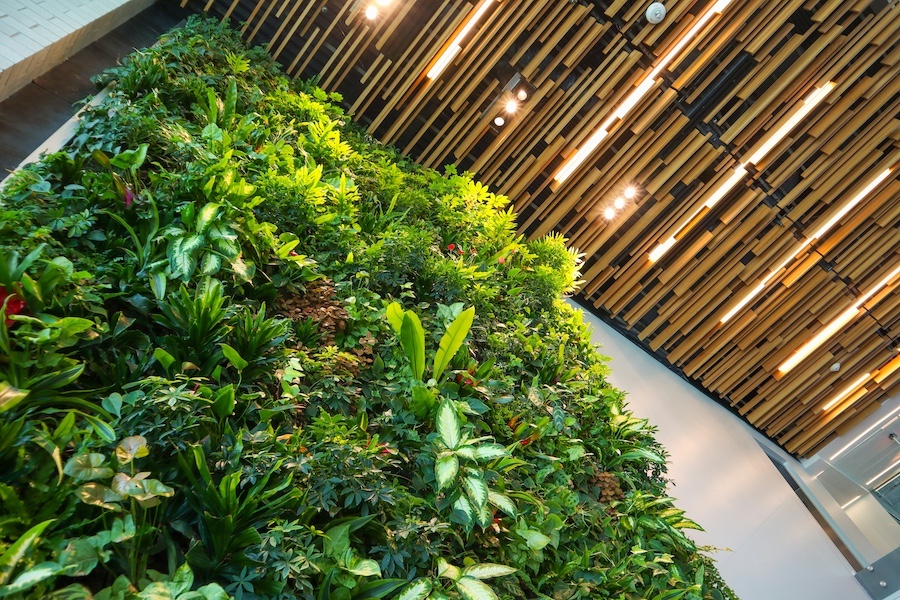
Green spaces are the simplest way of making an office feel circular. Instead of spending money on plants made out of plastic, investing in something like a “green wall” can actually raise productivity, while also creating a more relaxing space. Green spaces are known to reduce stress, clean the air and dampen noise. Plus, they don’t take up much room, and they quietly improve the look of the place.
2. Furniture from recycled materials
Choosing furniture from makers who work with recycled or reclaimed materials is one of the fastest circular wins available. Most of the time it’s also cheaper to buy good quality furnishings built from old materials than to re-buy cheap ones every couple of years. Ask suppliers about take-back and repair schemes while you’re at it — that’s what turns a purchase into a loop. Additionally, it gives your office a new and cool look.
3. Smart kitchen setups
Ever wondered how to make your office kitchen more circular? It’s a space where a lot of small things add up: automated lighting, water conservation systems, eco-friendly materials, energy-optimising appliances. Not only does this help the environment, it saves resources and, long term, money.
Which circular office ideas actually save money?
If you need to make the business case to someone who doesn’t care much about circularity, this is the section to point at. Each of these four ideas replaces a service you’re already paying for with a version that costs less, and none of them require capital expenditure — they’re contract renewals and supplier switches.
That’s also why they’re the fastest to implement. A composting contract, a procurement platform, an e-waste collector and a search engine are all decisions somebody in your organisation makes anyway, usually once a year. The question below is simply what you choose the next time that renewal lands on your desk.
4. Composting contracts
Composting contracts are agreements between businesses and organic waste haulers that help companies manage their materials responsibly. Instead of transporting waste to landfill, the resources are composted, sent to recycling facilities or reclaimed in other processes. It’s a visible environmental win, and it lowers municipal waste disposal fees.
5. Paperless procurement
Think of it as digital management of documents, signatures and purchases through clouds or electronic workflows. Businesses can use it to speed up processes while keeping better accuracy. Data entry mistakes are less likely in an automated system, and costs drop as printing, storage and shipping disappear.
6. E-waste recycling schemes
Electronic devices are a huge factor in office waste. With e-waste recycling schemes, devices get collected, sorted and processed, which prevents landfill pollution while keeping you inside legal frameworks like the EU’s WEEE Directive. It’s an easy way to uphold international environmental law — and to recover materials that are genuinely valuable.
7. Sustainable search engines
The internet is non-negotiable for modern work life. Search engines play a big role here, and they’re often not very sustainable. Encouraging coworkers to use a platform that puts its funding into planting trees or supporting renewable energy is a small change with a nice side effect on culture.
| Idea | What it replaces | Typical benefit |
| Composting contract | Mixed landfill waste | Lower disposal fees |
| Paperless procurement | Printing, storage, courier | Fewer errors, lower spend |
| E-waste scheme | Drawer full of old laptops | Compliance + material recovery |
| Recycled furniture | 3-year replacement cycle | Longer asset life |
How do you build a circular office culture?
Here’s the uncomfortable part: a beautifully designed sorting station with the wrong things in it is just an expensive bin. Every circular office eventually runs into the same wall, which is that the systems only work if people actually use them, and people use things they understand and don’t resent.
The three ideas below are therefore less about infrastructure and more about participation. One changes a default (what your catering arrives in), one makes learning social, and one takes the whole thing outside the building. Together they turn circularity from a policy your colleagues comply with into something they’d notice if you removed it.
8. Reusable catering norms
The food sector is an undervalued component of a circular office. Reusable catering norms minimise waste — offering reusable containers, for example — and nudge people to be more sustainable in their daily lives too. It also covers legal mandates, since businesses are required to move away from single-use plastics towards friendlier packaging.
9. Sustainability events
Why not combine sustainability with team building? Have you ever organised a “green event” at your company? A clothes swap or an eco-trivia contest strengthens team spirit while making employees more aware of sustainability — and lets them be part of the learning process interactively.
10. Volunteering activities
Outside your own walls, a volunteering board with options like neighbourhood clean-ups gives colleagues the choice to participate in their community together. Circularity that leaves the building tends to stick.
Frequently asked questions
These are the three questions that come up in almost every first conversation we have about circular offices — worth answering before you take any of the above to a colleague.
How is a circular office different from a sustainable office? A sustainable office reduces its impact. A circular office redesigns the flows — what comes in, how long it stays, and where it goes next.
Where should we start? With a waste audit. You can’t close loops you haven’t measured, and the audit almost always finds savings nobody expected.
Does this work for a small office? Yes. Composting contracts, paperless procurement and reusable catering scale down easily.
Let’s round this up
So, did you already get inspired by these suggestions? Now that you’ve seen how easy it is to make your office circular — and gain benefits while doing it — the only thing left is to find out where your own material flows are leaking.
Learn more about our Circular Office Ideas – Designing Out Waste at Work Workshop
