
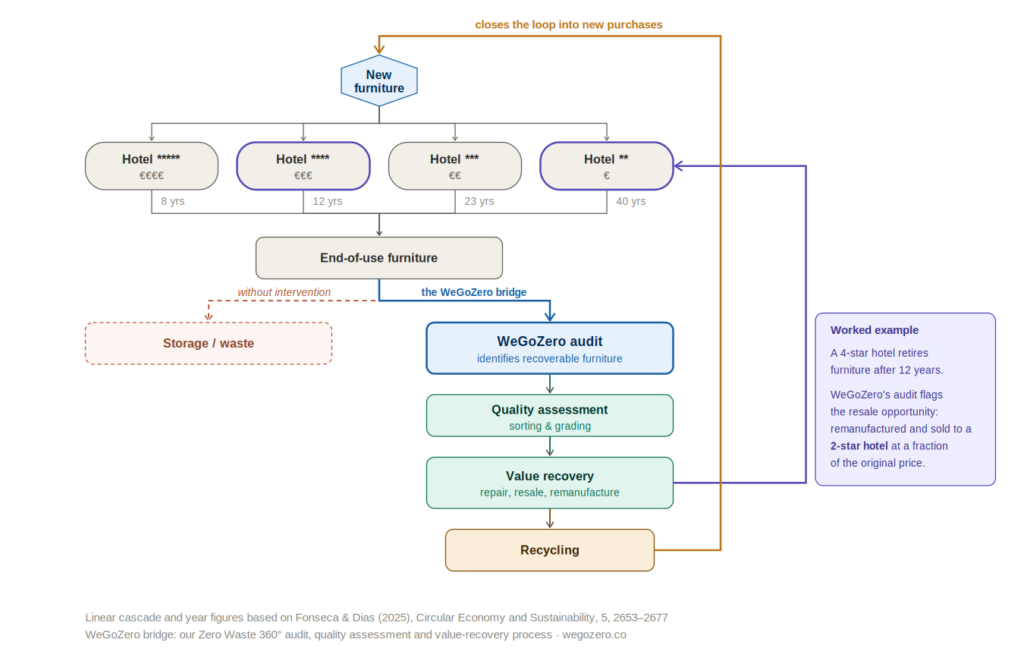
Most hotels still treat waste as a line item to minimise — something to pay someone else to take away. The more useful shift is to treat it as an asset to manage: a source of both cost reduction and revenue creation. Hotel furniture is one of the clearest places to see this in practice, and it’s exactly the kind of gap our Zero Waste 360° for Hospitality program is built to close.
The linear default
A recent grounded-theory study of circular economy adoption in hospitality — Fonseca & Dias (2025), Adopting Circular Economy in Hospitality: A Grounded Theory Approach, published in Circular Economy and Sustainability — interviewed 25 organisations, from high-end and budget hotels to furniture suppliers, and maps out how furniture actually moves through most properties today. Furniture is purchased, used, and then, once it no longer fits the property’s standards, it is stored, left underused, or discarded. New furniture is bought to replace it.
This is inefficient in two directions at once. Environmentally, usable items end up as waste. Financially, hotels pay for storage or disposal on one end and for full-price replacement on the other — while the item they’re storing may still hold real value for someone else.
Where the friction actually is
The study’s central finding is that circularity doesn’t fail because it’s impossible — it fails because no one owns the handoff. High-end hotels in particular struggle to resell outdated furniture: finding a buyer takes time and staff, and large, uniform batches of similar pieces are hard to place in secondary markets. So items sit in storage, occupying space and losing recovery value, while new stock is purchased regardless.
The study also found real disparity by category: high-end hotels tend to lead on circularity, through leasing, refurbishment and buyback programs, while budget hotels face financial and logistical barriers that limit how far they can engage. Lower-category hotels are often looking for exactly what high-end properties are trying to offload: functional furniture at a lower price point. The mismatch isn’t about the furniture’s usefulness — it’s about the absence of a system connecting supply to demand across tiers.
Four ways this becomes value
- Cost reduction through extended lifespan. Repair and refurbishment delay or avoid new purchases.
- Lower storage and disposal costs. Redirecting unwanted furniture into secondary markets clears space and cuts waste-handling fees.
- New revenue streams. Suppliers and high-end hotels can build maintenance, refurbishment, leasing, and take-back offerings around furniture that would otherwise be a sunk cost.
- Stronger sustainability reporting. Measurable diversion and reuse data supports credibility with guests, corporate clients, and regulators — and feeds directly into CSRD, ISO 14001, Green Key, LEED, BREEAM, and TRUE zero-waste reporting.
The insight underneath all four
Waste only becomes valuable when there’s an organised system around it — collection, quality assessment, repair, redistribution, resale, and data tracking. Remove any one of those steps and the loop breaks: furniture goes back to sitting in storage, and the hotel pays twice, once to keep it and once to replace it.
That’s the gap between the two models in the paper’s own figures. The linear model (Fig. 1) cascades new furniture down through star tiers — a 5-star property replaces after roughly 8 years, handing down through 4-, 3- and 2-star hotels at falling price points — before ending in storage, inutilization, or waste. The circular model (Fig. 2) keeps the same cascade but closes it: every tier feeds a remanufacture stage, and a final recycling stage returns recovered material into new furniture purchases, so the loop restarts instead of dead-ending.
How we put this into practice
This is the logic behind our own Zero Waste 360° methodology — Audit, Enable, Engage, Earn — applied to hospitality’s specific waste and material streams. On the audit side, we’ve taken this further with Yasmine Mahmoudieh, the London-based architect and interior designer behind Impact Design Now, through a joint offering that pairs our audit work with her regenerative design practice:
- Discover (WeGoZero): an on-site audit baselines waste and material flows, diversion rate, circularity opportunities, and identifies reusable materials — including furniture — with resale value.
- Transform (Yasmine Mahmoudieh): those findings become a regenerative design strategy rooted in the hotel’s own identity and heritage, with a prioritised implementation roadmap.
- Verify (WeGoZero): re-measurement after implementation, reported against CSRD, ISO 14001, Green Key, LEED, BREEAM, or TRUE standards to evidence the gain and unlock green financing.
The closed loop is the point: the materials our audits identify as recoverable — furniture included — return to the space as design rather than leaving as waste. In hotels we’ve worked with, this kind of approach has taken waste diversion from a typical 43% up to 90%, cut waste-related costs by an average of 35%, and opened over €10k a month in potential new revenue from material recovery.
If your property is still treating furniture turnover as a disposal problem rather than a recovery opportunity, that’s usually the first place a Zero Waste 360° for Hospitality audit finds value.
Source: Fonseca, D. B., & Dias, Á. (2025). Adopting circular economy in hospitality: A grounded theory approach. Circular Economy and Sustainability, 5, 2653–2677. doi.org/10.1007/s43615-025-00562-y
Learn more: wegozero.co · Zero Waste 360° for Hospitality · Yasmine Mahmoudieh / Impact Design Now
